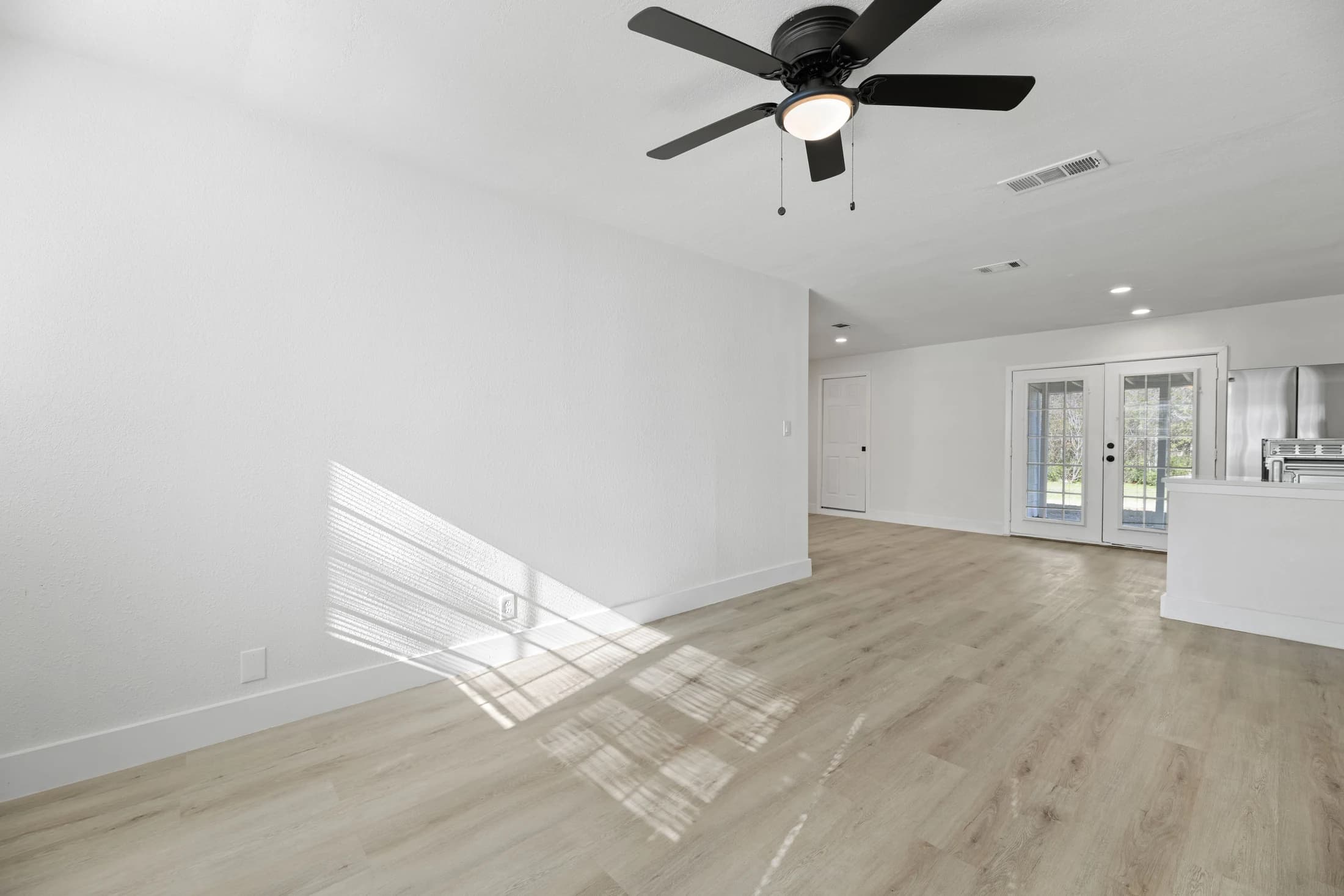
Before flooring installation, agree who clears each room, where its contents will go and when the room becomes available again. Record furniture-moving exclusions, appliance responsibilities, delivery space and a usable route through the home. Clearing belongings is separate from the installer’s assessment and preparation of the floor beneath them.
Separate room readiness from floor readiness
An empty room can still need technical preparation. This guide covers household belongings and access before installation; the installer must separately assess the floor, product requirements and installation conditions. Do not interpret a cleared room as approval of the substrate or a promise that installation can start immediately.
For a DFW homeowner replacing flooring in an occupied home, begin with the exact rooms included in the proposal. Include closets and connecting areas when they are in scope. Mark retained rooms and belongings that must remain accessible. A room list is more useful than a general instruction to get the house ready.
Make one room-readiness record with the installer
Shaw’s preparation guidance advises clearing furniture and belongings and confirming which associated services are included. Use that as a discussion prompt for your own contractor’s written scope. A retailer’s moving policy does not establish what your independent installer has agreed to do.
For every room, assign the task to a named responsible person or business and record its deadline. If responsibility is unresolved, keep it visibly open rather than assuming the installation crew will handle it on arrival.
On a small screen, scroll sideways to read each confirmation question.
| Task | Record before installation | Confirmation needed |
|---|---|---|
| Small and fragile items | Where valuables, wall decor, books and loose belongings will be stored. | Who packs and moves them before the crew arrives? |
| Large furniture | Each item, proposed destination and any disassembly. | Is moving included, and which items are excluded? |
| Appliances and connected equipment | Equipment affected and any required specialist work. | Who disconnects, moves, reconnects and checks it? |
| Materials and delivery | Agreed delivery location and product-specific storage requirements. | Where can materials remain without blocking household access? |
| Work and travel routes | Entrance, carrying route, protected areas and rooms kept in use. | Who sets up protection and keeps the agreed route available? |
| Return to use | When belongings may return and how the new floor is protected. | Which product instructions and installer checks control the timing? |
A homeowner coordination record, not an installation specification. Record actual scope and instructions; do not infer free moving or a guaranteed date.
Plan storage destinations before moving anything
Walk the proposed route for each large item. A sofa moved into a hallway may clear the work area while preventing access to a bedroom. A spare room may be useful storage only if it is outside the installation scope and still works for the household. Confirm the destination before packing the room.
Group boxes by room and label what must be available during the work. Keep daily essentials accessible in the agreed living area. Photograph furniture arrangements and cable labels if that will help with reassembly, while keeping private documents and valuables secured. Ask the movers or installer to assess heavy or awkward items; do not attempt a risky move to meet a preparation deadline.
Resolve moving exclusions and connected appliances
Ask specifically about pianos, aquariums, safes, glass-front cabinets and other items needing special handling. The important answer is the arrangement for your actual item: who handles it, what preparation is needed and whether a separate mover is required. A general furniture-moving line may leave these details open.
Connected appliances require a separate conversation. Identify affected water, gas or electrical connections and ask who is qualified and responsible for each task. Clearing a room is not a reason for the homeowner to improvise a disconnection. Record reconnection and any checks as well as removal, so a returned appliance is not mistaken for a completed task.
Keep delivery space and household routes in the same plan
Materials may need space before the installation appointment. Ask the installer to identify the requirements for the exact flooring product and where delivery should be placed. Do not assume every product needs the same acclimation period or that a garage is an acceptable storage location.
Lowe’s preparation guide highlights access routes and alternative use of kitchens or bathrooms during the project. Apply those questions to your room list: which facilities remain available, how will pets be kept away from work and what happens if a phase takes longer than expected? Agree on the work boundary with the contractor rather than changing ventilation or sealing routes yourself.
Worked example: an empty living room can still block the next phase
Imagine a hypothetical household replacing flooring in a living room and the adjoining hall. They initially plan to move the living-room furniture into the hall. Their room-readiness review reveals that the hall is both part of the installation and the route to the bedrooms. The first moving plan therefore does not solve the actual access problem.
They ask the installer about the proposed sequence, identify suitable storage outside the work area and confirm who handles the largest pieces. Their written record separates the first move, any later move and the return of furniture after the installer’s product-specific instructions allow it. This is an illustrative planning example, not a RIQOL customer story or a promise that phased moving will suit every installation.
Agree on the return of belongings too
Before installation begins, ask when the crew will confirm that the area is ready for belongings and how furniture should be returned and protected on the selected floor. Ask about any remaining trim, appliance or inspection tasks. Avoid scheduling a heavy return move solely from an estimated finish date.
RIQOL is developing a contractor-matching service. It does not install flooring, move belongings or provide an installation estimate. Use the readiness record to prepare for discussions with an independent contractor and compare the agreed work, exclusions and responsibilities.
A few more answers
Does flooring installation normally include moving all furniture?
Do not assume so. Ask the installer which moving tasks are included, which items are excluded and whether disassembly or specialist movers require a separate arrangement.
Can I store flooring in the garage before installation?
Confirm the exact product’s storage and conditioning instructions with the installer. A convenient location is not automatically suitable for the material.
Does clearing the room mean the floor is ready for installation?
No. Room clearing and technical substrate assessment are separate tasks. The installer must confirm the appropriate conditions for the selected flooring system.
When can I move furniture back?
Ask the installer for product-specific return-to-use instructions and confirmation of any remaining work. Do not apply one waiting period to every flooring material or installation method.
Further reading
Explore the next step
Learn about flooring installation, or find your DFW service area.
This planning guide was prepared with AI assistance. It provides general homeowner information, not a property inspection, quote, or project-specific specification. Product instructions and the assessed conditions should guide actual work.